_edited.png)
What shame says about your team, and why explosive reactions to difficult conversations might actually be an appropriate reaction to the system...

When someone reacts to a performance conversation with anger, tears, or a defensiveness that seems wildly out of proportion to what was actually said, the easy read is that they're being difficult, or too sensitive, or can't take feedback. I want to offer a different read, because I think it's usually more accurate and considerably more useful.
That reaction is very often shame. And shame, according to Brené Brown's decades of work on the subject, isn't really about the specific criticism at all. At its core, shame is the fear of disconnection, the fear that something you've done or failed to do makes you unworthy of belonging to the group you're part of.
There's a plausible evolutionary logic underneath that too. For most of human history, being cast out of your group wasn't an inconvenience, it was a genuine threat to survival. No group meant no protection, no shared resources, no help raising children or fending off danger. So it makes sense that we'd evolve an intensely powerful, fast-acting alarm system for anything that threatens our standing within the group, one that fires long before our conscious, rational brain gets a say in the matter. That's a big part of why shame responses feel so disproportionate, so fast, and so hard to talk yourself out of in the moment. You're not overreacting to a comment about a missed deadline. You're reacting to what your nervous system is reading as a threat to your place in the tribe.
Which brings me to the actual point I want to make, because this isn't really an article about individual psychology.
If one person on your team has a strong reaction to a difficult conversation, that's just being human, and it tells you very little on its own. People are individuals, and you genuinely can't predict or control every individual response.
But if this is a pattern, if difficult conversations across your team regularly produce outsized shame responses, anger, distress, shutdown, that's not a collection of individually thin-skinned people. That's very likely a signal about the underlying system. Specifically, it's worth asking whether your team has a genuine problem with connectedness. Do people feel like they truly belong there, secure in their standing with their colleagues and their leader, independent of any single piece of feedback? Or is everyone quietly operating from a baseline of insecurity about their place in the group, which means any critical conversation lands not as information, but as an existential threat to belonging?
If it's the latter, no amount of coaching people individually on "how to receive feedback better" is going to fix it, NOR is any targeted training for leaders in delivering the feedback better, because you'd be treating a system problem as a skills problem. The actual work is building genuine connectedness and a secure sense of belonging and safety across the team, so that a hard conversation can land as exactly what it is, useful information about work, rather than a referendum on whether someone still belongs.
So next time a difficult conversation goes sideways and the reaction feels bigger than the moment warranted, the more useful question usually isn't "what's wrong with this person." It's "what does this tell us about how safe and connected people actually feel here," especially if you notice it happening more than once.
Want some ideas on building connected and a sense of community in your team? Let's chat!
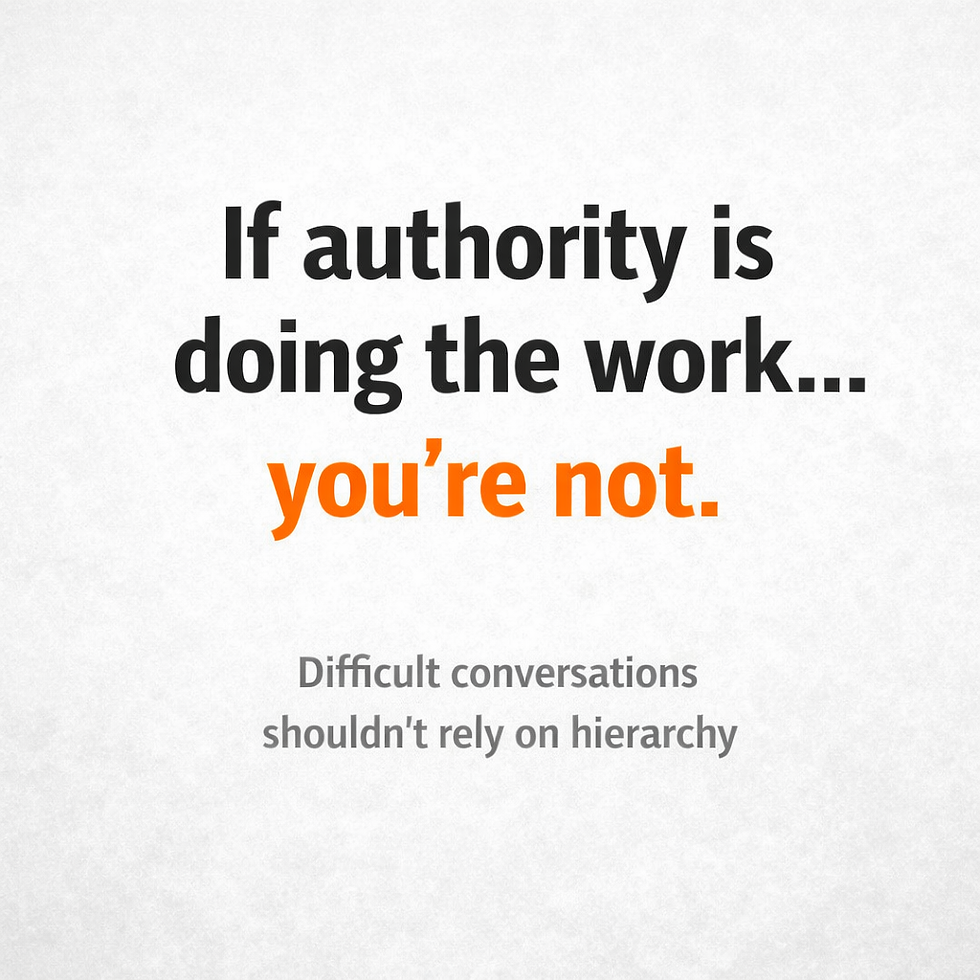
(Speaking Of Nothing Related: while it feels a bit like cheating on my new BFF Claude, I have to give ChatGPT points for reading the brief on this image creation!!)


Comments