_edited.png)
Leadership add complexity to avoid grief.
- Dr Jessica Moore-Jones

- Mar 14
- 3 min read
Yesterday, in a completely different conversation about my life, I realised something about myself as a self-proclaimed excellent problem solver.
“We add complexity to avoid grief.”
It was about travel. About world schooling. About community. About the temptation to design a complicated, clever, logistical masterpiece of a life. Rather than sit still long enough to admit something simpler and harder - some things cannot be solved by movement.
And then I realised how often this shows up in leadership.
In clinics.
In organisations.
In culture work.
We add complexity to avoid grief.
Instead of admitting that a team member is not right for the role and that letting them go will hurt, we build performance frameworks, layered feedback systems, new reporting structures, additional KPIs, mediation sessions or role redesigns. We create complexity around a truth we do not want to face.
Instead of acknowledging that a workplace culture has eroded and that trust has been lost, we roll out engagement surveys, values posters, wellness initiatives, pizza lunches and communication workshops.
Instead of grieving the fact that growth has plateaued or that a dream version of the business is no longer viable, we launch a new service line, restructure the org chart, add another layer of management.
Complexity feels productive.
Grief feels paralysing.
So we choose productive.
But grief has a function.
Grief is what happens when reality collides with expectation. It is the emotional cost of accepting that something is not what we hoped it would be.
In leadership, that grief might sound like:
This person is not going to become what I wanted them to become.
This team is not as cohesive as I imagined.
This culture is not as healthy as we tell ourselves.
This role is heavier than I want it to be.
This business model no longer fits the world we operate in.
Those are painful admissions. They threaten identity. They threaten ego. They threaten hope.
So instead, we redesign the spreadsheet.
Here is the uncomfortable part.
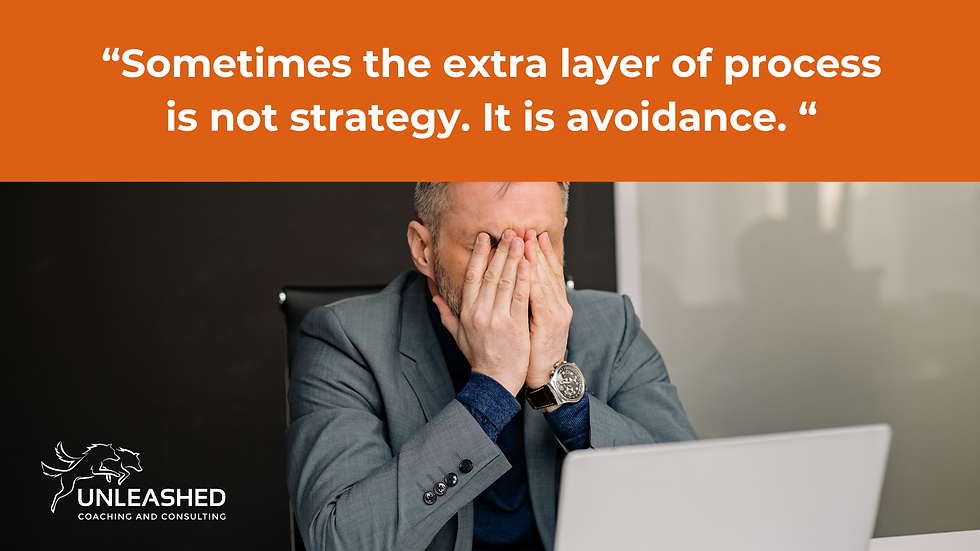
Sometimes the extra layer of process is not strategy. It is avoidance.
Sometimes the new initiative is not innovation. It is a distraction from loss.
And sometimes what a culture needs is not another intervention, but a period of collective honesty.
I have seen leaders exhaust themselves trying to engineer their way out of something that required mourning.
Mourning the fact that the high performer is toxic.
Mourning the fact that the team will not all come with you into the next phase.
Mourning the version of yourself that could hold it all together without cost.
We talk a lot about resilience as endurance. As pushing through. As building capacity.
But real resilience often looks like restraint:
It looks like saying, this is what it is.
It looks like tolerating the discomfort of not fixing.
It looks like sitting with the loss long enough that the next step becomes clear instead of frantic.
Grief simplifies.
Once you accept that something is over, or different, or not salvageable in the way you hoped, decision making becomes cleaner.
Energy stops leaking into fantasy.
Conversations become more direct.
Boundaries become easier to hold.
This does not mean complexity is always wrong. Organisations are complex systems. Good leadership requires structure.
But before you add the next initiative, the next policy, the next role, the next training program, it is worth asking a brutally simple question:
Is this solving a problem?
Or is this protecting me from feeling something?
If we are brave enough to answer that honestly, culture work changes.
Leadership becomes less about constant motion and more about clear sight.
And sometimes the most strategic move available is not to build something new, but to let something go and grieve it properly.
That is not weakness.
That is maturity.
And in my experience, it is the difference between leaders who are perpetually overwhelmed and leaders who are quietly grounded.
If this hits uncomfortably close to home, that might be the point.


Comments